

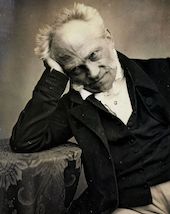
Summary: Goethe and Schopenhauer: The Colours of Conflict
One evening in Weimar, the young Schopenhauer meets Goethe and strikes up a conversation with him.
But already his dark, irritable temperament is playing tricks on him… and before long the relationship between the two men turns sour.
Here is the story of one of the most famous quarrels in the history of philosophy…
A Meeting of Minds
The year is 1813, in Weimar, capital of the Duchy of Saxe-Weimar-Eisenach. This evening we are guests in the home of Johanna Schopenhauer, a brilliant woman of letters who hosts a salon twice a week. At these gatherings one might encounter, among others, the poet Wieland, the philosopher Friedrich von Schlegel, and above all the universal genius Goethe himself.
In fact, it was precisely in order to be closer to the great man that Johanna Schopenhauer agreed to move to Weimar: she held him in the highest admiration, and had managed to persuade him to grace the enchanted company with his august presence.
But on this particular day it is another distinguished visitor who joins the company: Arthur, Johanna’s son. He is twenty-seven and has just had his thesis, On the Fourfold Root of the Principle of Sufficient Reason, published. The two men are introduced, and Goethe’s curiosity is piqued. In November he sends Schopenhauer a letter of congratulations after reading the thesis and invites him to visit.
He wishes to talk to him about one of his own works, his Theory of Colours, written in 1810, in which he takes issue with Newton and which has contributed to his renown. At the end of their discussions he advises the young man to devote his reflections to this problem of colour.
This advice does not, of course, fall on deaf ears. Thrilled at the prospect of joining a debate between Goethe and Newton—and of adding his own name to the conversation, Schopenhauer sets about writing his own work on the subject, On Vision and Colours. He sends Goethe the manuscript, together with a letter asking him to see it through the press.
First, nothing. No reply at all. Had the manuscript gone astray? Schopenhauer grew anxious and sent Goethe another letter:
It troubles and disturbs me to know that one of my manuscripts has been out of my hands for eight weeks, without my even being fully certain that it has reached the one destination intended for it […] and that I do not even know whether it has been well received, or indeed how it is faring.1
He appeals to Goethe’s good heart: This uncertainty concerning the only thing that matters to me is disagreeable and tortures me, and at times my hypochondria finds in it food for the most unpleasant and senseless chimeras. In order to put an end to all this and to stop the torment of an expectation disappointed afresh each day, […] I now beg Your Excellency to return my work to me.
2
Goethe could hardly remain unmoved by this cry of distress, and at last, on 23 October 1815, the long-awaited reply reaches its recipient.
What does it say? Before we look at that, we must first understand what is at stake in substance.
The debate on colour
Formidable, this question of colour! And highly complex, the debate that sets these three men against one another…
What is colour? Is it a property of the object considered? Or does it reside in the eye of the beholder?
Newton offers a mathematical approach to colour, developed on the basis of a ‘crucial experiment’ described in a letter of 1672: in a darkened room, light enters through a small hole in the shutter. When he places a prism in the beam, he sees the light break up into different colours on the opposite wall. His theory seeks to explain this phenomenon.
Goethe, for his part, rejects this mathematical approach. As a proponent of Naturphilosophie, he looks instead for its spiritual characteristics. For him, every colour, plotted on his famous colour wheel, is obtained through a mixture of light and shadow.
In reality, then, he is no longer interested in the nature of light as such, but in the human perception of colours, and in this respect the exchange between Newton and Goethe is a kind of dialogue of the deaf:
Modern physics does not know ‘light’ in Goethe’s sense, nor ‘darkness’ either. Colour theory therefore moves in a domain that the conceptual determinations of physicists do not touch at all. Physics simply ignores the basic concepts of Goethe’s theory of colours. For that reason it cannot judge it from its own point of view. Goethe begins precisely where physics stops.3
Goethe assumed that Schopenhauer would simply carry his work further, filling in and refining certain details of his theory, like a hired hand faithfully completing the task assigned to him. That was to misjudge Schopenhauer badly…
A few months were enough for him to construct a theory of his own, markedly different, even if he did take up some of Goethe’s insights. Whereas Goethe regards colour as an objective property of things, Schopenhauer, influenced by Kantian idealism, situates it in the observing subject. They disagree, for example, about the nature of white. Schopenhauer assigns much greater importance to the fundamental role played by the retina. These are only a few instances of the divergences that separate the two men.
To all this there is added, for Goethe, a wound to his pride: Schopenhauer presents Goethe’s work as a collection of ‘data’ from which one might erect a truly systematic theory of colour – namely his own.
Matters of ego
In this letter, Goethe therefore takes his distance from Schopenhauer. After the usual compliments, he sidesteps the issue and refuses any debate on the points of disagreement:
If I come to that in which you differ from me, I feel all too strongly how much a stranger I am to such matters, to the point that it seems difficult, indeed impossible, for me to take a contradiction into account, to resolve it or to accommodate myself to it. I therefore prefer not to touch on these contentious points.4
He tries to divert the impetuous force he senses in the fierce philosopher towards some other target, by referring him to the good offices of Dr Seebeck, who, for his part, has kept within the narrow perimeter Goethe had marked out for him: He has noticed various oversights, pointed out a few careless mistakes, set out certain points and checked others, contributed a few innovations and, above all, has rightly judged the strengths and weaknesses of the opponents.
5
This advice plunges Schopenhauer into a fury: he had been in dialogue with Goethe and Newton, and now here he is relegated, outside History, to dealing with some obscure underling.
His reply is not long in coming: some two weeks later it takes the form of a long letter.
After the conventional courtesies, he presses Goethe to accept the debate and enter the fray:
The error must necessarily lie either in my work or in Yours. In the former case, why should Your Excellency deny Yourself the satisfaction – and deny me the lesson – of drawing, in a few words, the line that would separate what is true from what is false in my book?6
Here he reveals a way of thinking that is somewhat… monolithic: My theory is the unfolding of a single, indivisible thought which must be either entirely false or entirely true; for that reason it resembles a vault from which not the smallest stone can be removed without bringing down the whole structure.
7
He also grants himself, with considerable generosity, the status of pioneer:
I am utterly certain that I have provided the first genuine theory of colour, the first in the whole history of science; I also know that one day this theory will be universally recognised and will be familiar to children in school.8
But was Goethe not envisaging the same destiny? Goethe, stripped of his status as pioneer in the eyes of History by a mere stroke of the pen?
Schopenhauer pays homage to him in his own fashion: I could never have achieved this without Your Excellency’s prior and greater merit. I also believe that this acknowledgement is expressed as much in the motto of my book as in its overall tone, and indeed in almost every line: I am nothing but your champion (this is also why I had hoped to be allowed to bear your coat of arms). I have even deliberately emphasised the few points on which I diverge from you, so that no one might take me for a blindly submissive partisan.
9
This, then, is what the young Schopenhauer, aged twenty-seven, an illustrious nobody, dares to say to Goethe, aged sixty-six, a genius celebrated throughout Europe:
In place of Newton’s THEORY, which You overthrew, You did not put forward a new one. That has precisely been my task […].
Goethe probably appreciated the following image:
If we compare Your Theory of Colours to a pyramid, then my theory occupies its summit, the indivisible mathematical point from which the whole of the great edifice unfolds, and which is so essential that without it the structure is no longer a pyramid, whereas it is always possible to subtract something from the base without its ceasing to be a pyramid. […] This edifice […] is Yours, […] but You have nonetheless left it to me truly to place upon it the summit that completes the pyramid and will defy the centuries.10
As for good Dr Seebeck, he is dismissed without ceremony: I do not see what this could lead to: the judgement of a private individual has far too little value for me. In Your Excellency’s case it is different: for You are not a private individual, but the unique one.
11
Disappointment
Goethe replies a few weeks later with a brief letter. Its content, even more than its length, is disappointing: once again he side-steps the issue and avoids entering into any substantive debate on the points of disagreement. And above all, he does not commit himself to publishing Schopenhauer’s treatise. He reassures him on only one point: he has not shown it to Dr Seebeck, thus avoiding any risk of plagiarism.
In January Schopenhauer replies with a letter in a plaintive key:
It seems that Your Excellency has once again forgotten us, myself and my theory of colours. My first hope, always uncertain, that you would help me to publish this work has gradually faded; the hope I cherished of at least hearing your judgement is likewise dissipating, after I have waited for it for nearly seven months.12
He asks him to return his manuscript.
Goethe sees the end of his torment, and of this exhausting correspondence, approaching. He allows himself the luxury of sending these consoling words:
I have seen only too clearly how much men can agree about objects and their phenomena, yet never succeed in bringing their points of view, their deductions and their interpretations into agreement, and how those who agree on principles are immediately divided when it comes to their application. And thus I have seen only too clearly that it would be labour in vain for us to try to understand one another. […] Let me know from time to time what you are working on and you will always find me interested, for although I am too old to make other people’s points of view my own, I should nonetheless very much like, as far as possible, to be historically informed about what you have thought and how you think.13
It did him little good, however, for in return he received one last severe dressing-down:
I cannot conceal how deeply it has grieved me not even to have obtained from You any serious engagement, any response or reply. […] These ardent hopes have gradually been extinguished; but after all this time, after having written so much, not even to know your opinion, your judgement, nothing, nothing but a hesitant commendation and the silent withholding of Your approval, without any counter-arguments given – that was more than I was capable of fearing.14
Nevertheless, he too brings this exchange to an end with these conciliatory words, which even display a certain panache:
Yet far be it from me to allow myself, even in thought, any reproach against You. For you have given to the whole of humanity, present and future, things so numerous and so great that everyone, within this general debt of mankind to You, finds himself a debtor, and no one will ever have the right to demand anything of You. But indeed, for me to find myself, in such circumstances, in such a state of mind, one had to be either Goethe or Kant; none of the others who have seen the sun in my lifetime would have sufficed.15
Conclusion
At twenty-eight, Schopenhauer brushed against glory. Under Goethe’s aegis, he might have enjoyed a dazzling start to his career and gathered honours in abundance.
But he was far too certain of being right… He who wrote a book on the subject, The Art of Always Being Right, was the first victim of this very trait of character. He did not become famous until the end of his life, and he himself would later make ironic remarks about this belated glory.
It is also worth noting that good Dr Seebeck, who wisely followed Goethe’s advice, has not passed into posterity. Did Schopenhauer’s excesses not, in the end, also contribute to his fame?
Author of the article:
Cyril Arnaud, founder of the website Philosophers.world
Author of Pirate fragments, poetic philosophy, and Axio, philosophy of values.
1 Correspondance complète, éditions Alive, Paris, 1996, p.20
2 p.20-21
3 Rudolf Steiner, Introductions aux œuvres scientifiques de Goethe, Montesson, Éditions Novalis (France), 2002, p.325
4 Archives Goethe-Schiller de Weimar, Lettre du 23 octobre 1815
5 Ibid.
6 Correspondance complète, p.24
7 ibid.
8 p.26
9 p.27
10 ibid.
11 p.28
12 p.30
13 Lettre du 28 janvier 1816
14 p.32
15 p.32-33